Jan 22, 2026
How AI is Revolutionizing the Tendering Process

Artificial intelligence (AI) is rapidly reshaping how organizations discover, evaluate, and win public tenders.
What was once a manual, document-heavy process is now becoming a data-driven, automated, and insight-rich discipline — changing the rules of competition for both large corporations and SMEs.
This article explores how AI is transforming each stage of the tendering process — and what that means for companies looking to stay ahead.
1. From Complexity to Clarity: The Tendering Challenge
Public procurement data is vast, fragmented, and constantly evolving.
Every day, thousands of new tenders are published across different platforms, in multiple languages, and with varying classification systems.
For most companies, this leads to:
- Hours spent searching and filtering irrelevant notices
- Missed opportunities due to late discovery
- Resource drain from repetitive administrative work
AI changes this dynamic by turning raw procurement data into actionable intelligence.
2. Stage One: Smarter Tender Discovery
Traditionally, tender discovery has been a manual search process — checking portals, downloading documents, and scanning for relevant keywords.
AI replaces this with continuous, automated monitoring.
How it works:
- Data aggregation: AI systems collect and normalize tenders from hundreds of national and EU sources.
- Semantic search: Instead of static keywords, AI understands the meaning behind your capabilities and matches accordingly.
- Pattern recognition: Algorithms identify recurring buyers, expiring contracts, and seasonal procurement trends.
🔍 Result: Companies get notified of relevant opportunities earlier — often days before competitors relying on manual searches.
3. Stage Two: Intelligent Pre-Qualification
AI also helps businesses determine which tenders are worth pursuing.
By analyzing structured and unstructured data, it can automatically filter opportunities based on your specific criteria.
Example filters:
- Contract value range
- Geographic scope
- Relevant CPV codes
- Experience or certification requirements
- Authority procurement behavior
This pre-qualification step ensures that only the most relevant tenders reach your team, reducing noise and focusing attention on high-probability wins.
⚙️ In platforms like Tenderbot.io, AI-driven pre-qualification saves SMEs hundreds of hours per year by screening tenders that don’t match their capability profile.
4. Stage Three: Data-Driven Bid Strategy
AI doesn’t stop at discovery — it also enhances how companies plan and position their bids.
By analyzing historical tender data, previous awards, and pricing patterns, AI provides insights such as:
- Which authorities consistently award to SMEs or local suppliers
- Typical contract renewal cycles
- Average project value and duration
- Common evaluation criteria and weightings
These insights help companies make smarter bid/no-bid decisions, allocate resources effectively, and craft more competitive proposals.
📈 In other words, AI turns procurement from guesswork into strategy.
5. Stage Four: Efficiency in Evaluation and Compliance
On the buyer side, AI is transforming tender evaluation as well — particularly in managing large volumes of submissions.
AI tools can:
- Detect incomplete or inconsistent responses
- Verify compliance with eligibility criteria
- Highlight anomalies or risks
- Support scoring processes with structured data extraction
While final decisions remain human, AI dramatically reduces administrative load and helps ensure objectivity and auditability.
6. Transparency, Fairness, and Trust
AI can only revolutionize procurement if it also upholds ethical and regulatory standards.
That’s why the most credible platforms focus on:
- Transparent algorithms
- GDPR-compliant data handling
- Traceable logic behind recommendations
- Clear separation between discovery and decision-making
🤝 The goal is not to replace procurement professionals — it’s to empower them with better information and more time for high-value work.
7. The Tenderbot.io Approach to AI-Driven Tendering
At Tenderbot.io, AI serves one clear purpose:
to simplify and accelerate the discovery of tenders that match your organization’s real capabilities.
Our platform:
- Continuously scans public procurement portals across Europe
- Uses intelligent matching to pre-qualify tenders by company-specific criteria
- Delivers relevant opportunities via a clear, explainable interface
- Operates fully within EU data protection and transparency standards
By combining automation with clarity and compliance, Tenderbot.io helps companies focus where it matters most — on preparing strong, timely, and winnable bids.
Conclusion
AI is not the future of tendering — it’s already here.
From discovery to evaluation, automation is redefining how organizations compete for public contracts.
For SMEs and enterprises alike, embracing AI-driven procurement tools is no longer optional — it’s the key to staying visible, relevant, and competitive in a rapidly digitalizing public sector.
Tenderbot.io stands at the center of this shift, helping companies move faster, work smarter, and win more — responsibly and transparently.
Related Blogs
See All Blogs


Streamline EU Tendering
Automate discovery and evaluation of public contracts, so you focus on bids that truly fit.
Begin Your Free TrialEU, EEA & Switzerland

Austria

Belgium

Bulgaria

Croatia

Cyprus

Czech Republic

Denmark

Estonia
Austria
Belgium
Bulgaria
Croatia
Cyprus
Czech Republic
Denmark
Estonia

Finland

France

Germany

Greece

Hungary

Ireland

Italy

Latvia
Finland
France
Germany
Greece
Hungary
Ireland
Italy
Latvia

Lithuania

Luxembourg

Malta

Netherlands

Poland

Portugal

Romania

Slovakia
Lithuania
Luxembourg
Malta
Netherlands
Poland
Portugal
Romania
Slovakia

Slovenia

Spain

Sweden

Iceland

Liechtenstein

Norway

Switzerland
Slovenia
Spain
Sweden
Iceland
Liechtenstein
Norway
Switzerland
Serving all European Union, European Economic Area countries and Switzerland.
EU Buyer Reach

Tender Bot tracks every public buyer across Europe and funnels the most relevant.
Save Time and Make Better Tender Decisions
Focus on the tenders that matter—Tender Bot automatically screens EU-wide public opportunities, ranks them against your capabilities, and delivers a shortlist you can act on. Spend less time sifting through notices and more time crafting winning proposals.
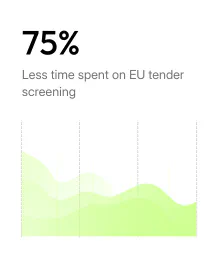

* Internal benchmark tests (July 2025) show that an experienced analyst needs about 15 minutes¹ to perform the first-pass qualification of a typical EU tender. With TENDERBOT IO, that same analyst can pre-qualify roughly 150 tenders in the same 15 minutes — around 10 tenders in ± 1 minute. This represents a reduction in screening time of well over 90 %. To stay conservative and cover variations in document length and working style, we therefore communicate “up to 75% time savings.
¹ Calculation assumes an average reading speed of ~2 minutes per A4 page and an average tender length of ~7 pages.