Dec 04, 2025
Navigating the EU Public Procurement Landscape: Key Regulations & Compliance You Should Know

Doing business with the public sector in Europe requires more than just competitive pricing — it demands a solid understanding of EU procurement rules, thresholds, and compliance obligations.
This article summarizes the key aspects of the EU public procurement framework and offers practical tips to help your company stay compliant while increasing its tender success rate.
1. The Foundations: EU Procurement Directives
The EU’s public procurement system is built on three core directives:
Directive 2014/24/EU – Public Procurement Directive
Governs contracts by public authorities (ministries, municipalities, agencies).Directive 2014/25/EU – Utilities Directive
Applies to entities operating in water, energy, transport, and postal services sectors.Directive 2014/23/EU – Concessions Directive
Regulates works and service concessions where suppliers gain revenue from user fees.
Each member state implements these directives through national legislation, meaning that while principles are shared across the EU, procedural details (submission portals, formats, timelines) can vary by country.
2. Core Principles You Must Know
The EU procurement framework rests on five key principles that every bidder must respect:
| Principle | Meaning for Suppliers |
|---|---|
| Transparency | Tender procedures and evaluation criteria must be clearly published and applied. |
| Equal Treatment | All bidders must have the same access to information and evaluation. |
| Non-Discrimination | No preference may be given to national or local suppliers. |
| Proportionality | Requirements must be relevant and not excessively burdensome. |
| Mutual Recognition | Certificates and standards from other EU states must be accepted. |
💡 Tip: Always review how contracting authorities apply these principles — misapplied criteria can be grounds for appeal or clarification.
3. EU Procurement Thresholds (2024–2025)
The thresholds determine when EU rules apply. Below these values, national procedures may take precedence.
| Contract Type | Contracting Authority | Threshold (EUR) |
|---|---|---|
| Supply & Service Contracts | Central Government | €140,000 |
| Supply & Service Contracts | Regional / Local Authorities | €215,000 |
| Works Contracts | All Authorities | €5,382,000 |
| Utilities Contracts | All Entities | €431,000 |
| Concession Contracts | All Entities | €5,382,000 |
(Values valid until Dec 2025; thresholds are revised every two years by the European Commission.)
4. Mandatory Compliance Documents
Participating in EU-level tenders often requires standardized documentation to prove eligibility and capability.
Typical examples:
- European Single Procurement Document (ESPD) — a self-declaration form covering exclusion and selection criteria.
- Declaration of Honour — confirming no conflicts of interest or grounds for exclusion.
- Proof of Financial Standing — audited accounts or bank letters.
- Technical & Professional References — project portfolios, key personnel, certifications.
📄 Note: The ESPD can be reused across tenders; update it periodically to save time.
5. Common Compliance Pitfalls
| Risk | Description | How to Avoid |
|---|---|---|
| Late Submissions | Electronic portals close automatically at the deadline. | Upload documents at least one hour in advance. |
| Incomplete ESPD | Missing signatures or unchecked boxes lead to disqualification. | Use the Commission’s online ESPD tool to validate entries. |
| Non-Eligible Team Members | Subcontractors or JV partners fail to meet criteria. | Verify partner compliance early in the process. |
| Misinterpretation of Selection Criteria | Requirements misunderstood or under-documented. | Request clarification within the Q&A period. |
6. Opportunities Beyond Borders
EU procurement is a single market — companies can bid for contracts across all member states.
Tender portals such as TED (Tenders Electronic Daily) aggregate EU-wide notices and allow suppliers to:
- Search by CPV code (Common Procurement Vocabulary)
- Filter by contract type, country, or authority
- Subscribe to alerts for new opportunities
Tenderbot.io enhances this process by automatically pre-qualifying tenders that fit your company’s criteria, saving valuable time in identifying relevant projects across multiple jurisdictions.
7. Appeals and Legal Remedies
Suppliers who believe procurement rules were breached can:
- File a clarification request before submission, or
- Submit a formal complaint or appeal after contract award.
Each EU country designates a review body (often a public procurement tribunal or court).
However, time limits are short — usually 10 to 15 days after notification.
⚠️ Always document communication with authorities and save submission proofs (receipts, emails, upload confirmations).
Conclusion
Navigating EU public procurement can feel complex, but once you understand its structure and compliance requirements, it becomes a predictable, rules-based process. Success depends on preparation, documentation discipline, and strategic focus on the right opportunities.
With Tenderbot.io, companies save hours of manual searching by automatically finding and pre-qualifying tenders that meet their capability and compliance profile — enabling you to focus on crafting winning bids, not deciphering regulations.
Related Blogs
See All Blogs


Streamline EU Tendering
Automate discovery and evaluation of public contracts, so you focus on bids that truly fit.
Begin Your Free TrialEU, EEA & Switzerland

Austria

Belgium

Bulgaria
Croatia
Cyprus
Czech Republic

Denmark

Estonia
Austria
Belgium
Bulgaria
Croatia
Cyprus
Czech Republic
Denmark
Estonia

Finland

France

Germany

Greece

Hungary

Ireland
Italy

Latvia
Finland
France
Germany
Greece
Hungary
Ireland
Italy
Latvia

Lithuania

Luxembourg

Malta
Netherlands

Poland

Portugal

Romania
Slovakia
Lithuania
Luxembourg
Malta
Netherlands
Poland
Portugal
Romania
Slovakia
Slovenia

Spain

Sweden

Iceland
Liechtenstein

Norway

Switzerland
Slovenia
Spain
Sweden
Iceland
Liechtenstein
Norway
Switzerland
Serving all European Union, European Economic Area countries and Switzerland.
EU Buyer Reach

Tender Bot tracks every public buyer across Europe and funnels the most relevant.
Save Time and Make Better Tender Decisions
Focus on the tenders that matter—Tender Bot automatically screens EU-wide public opportunities, ranks them against your capabilities, and delivers a shortlist you can act on. Spend less time sifting through notices and more time crafting winning proposals.
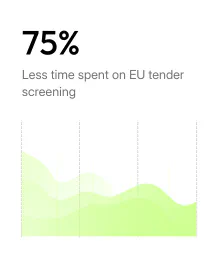
* Internal benchmark tests (July 2025) show that an experienced analyst needs about 15 minutes¹ to perform the first-pass qualification of a typical EU tender. With TENDERBOT IO, that same analyst can pre-qualify roughly 150 tenders in the same 15 minutes — around 10 tenders in ± 1 minute. This represents a reduction in screening time of well over 90 %. To stay conservative and cover variations in document length and working style, we therefore communicate “up to 75% time savings.
¹ Calculation assumes an average reading speed of ~2 minutes per A4 page and an average tender length of ~7 pages.