Dec 25, 2025
The Hidden Cost of Manual Tender Searching (and How to Fix It)

Every week, companies spend hours scanning tender portals, downloading PDFs, and trying to determine which opportunities actually fit their capabilities. At first glance, this seems like a routine administrative task, but in reality, manual tender searching is one of the biggest hidden costs in public procurement.
This article breaks down the true impact on your time, budget, and competitiveness — and shows how to fix it.
1. The Illusion of “Free” Tender Searching
Most organizations assume that manually checking tender portals costs nothing.
After all, the portals are public — no subscription fees, no vendor lock-in.
But the real cost lies in labor hours and missed opportunities.
🕓 Example: If one employee spends 2 hours per day scanning portals, that’s 40 hours per month — roughly half a part-time position spent on repetitive searches.
Multiply that across departments or regions, and you’re losing thousands of euros monthly without realizing it.
2. Quantifying the Hidden Costs
| Cost Type | Description | Typical Impact |
|---|---|---|
| Labor Hours | Time spent searching, reading, and filtering irrelevant tenders. | €800–€1,200/month per employee (based on €25–30/h). |
| Opportunity Cost | Time that could have been used for preparing proposals or client delivery. | Loss of 1–2 qualified bids per month. |
| Late Discovery | Finding tenders after competitors already started preparing. | Reduced win probability (by up to 25%). |
| Error & Oversight | Missing tenders due to poor filtering or manual fatigue. | Direct loss of potential revenue. |
📉 The “cheap” approach of manual searching often becomes the most expensive in terms of ROI.
3. Human vs. System Efficiency
Manual searching has one major limitation: humans can’t scale.
Procurement portals publish thousands of notices daily, across multiple formats and languages.
No single person can efficiently:
- Track all relevant CPV codes.
- Combine national and EU-level data.
- Keep filters perfectly updated.
- Avoid human error during repetitive tasks.
In contrast, automated systems process structured and unstructured data in real time, 24/7, without fatigue or bias.
4. How Hidden Costs Affect Competitiveness
The cost of inefficiency isn’t only financial — it’s strategic.
- Delayed reactions: Competitors discover tenders faster, giving them more preparation time.
- Lower proposal quality: Less time for analysis, design, and pricing optimization.
- Team frustration: Staff burn out doing monotonous searches instead of high-value work.
- Poor forecasting: Leadership can’t rely on accurate data for pipeline planning.
🚫 Being “too late” is the most common — and preventable — reason for losing tenders.
5. How to Fix It: Modernizing Tender Discovery
Transitioning from manual to automated discovery doesn’t mean replacing people — it means amplifying their effectiveness.
Here’s what a modern approach looks like:
- Centralize tender data — aggregate all national and EU notices in one place.
- Automate pre-qualification — filter tenders based on your company’s size, location, and service profile.
- Use smart notifications — deliver relevant tenders directly to your inbox or collaboration tools.
- Integrate with your CRM — push qualified tenders straight into your sales pipeline.
- Measure and improve — track how many tenders convert into bids and wins.
With these foundations in place, tender monitoring becomes a strategic, data-driven process — not an administrative burden.
6. The ROI of Automation
Companies that adopt automated discovery report:
- Up to 75% time savings in tender identification.
- 40% increase in relevant opportunities found.
- Higher win rates due to improved preparation time.
The result?
Your team spends less time searching and more time winning.
Conclusion
Manual tender searching feels familiar, but it’s an invisible drain on productivity, morale, and profitability.
Every minute spent manually filtering notices is a minute lost on strategy, relationships, and proposal quality.
By modernizing your discovery process with intelligent tools like Tenderbot.io, you:
- Eliminate repetitive work,
- Capture tenders before competitors do, and
- Free your team to focus on high-impact bidding.
Stop paying the hidden price of inefficiency — start competing smarter.
Related Blogs
See All Blogs


Streamline EU Tendering
Automate discovery and evaluation of public contracts, so you focus on bids that truly fit.
Begin Your Free TrialEU, EEA & Switzerland

Austria

Belgium

Bulgaria

Croatia

Cyprus

Czech Republic

Denmark

Estonia
Austria
Belgium
Bulgaria
Croatia
Cyprus
Czech Republic
Denmark
Estonia

Finland

France

Germany

Greece

Hungary

Ireland

Italy

Latvia
Finland
France
Germany
Greece
Hungary
Ireland
Italy
Latvia

Lithuania

Luxembourg

Malta

Netherlands

Poland

Portugal

Romania

Slovakia
Lithuania
Luxembourg
Malta
Netherlands
Poland
Portugal
Romania
Slovakia

Slovenia

Spain

Sweden

Iceland

Liechtenstein

Norway

Switzerland
Slovenia
Spain
Sweden
Iceland
Liechtenstein
Norway
Switzerland
Serving all European Union, European Economic Area countries and Switzerland.
EU Buyer Reach

Tender Bot tracks every public buyer across Europe and funnels the most relevant.
Save Time and Make Better Tender Decisions
Focus on the tenders that matter—Tender Bot automatically screens EU-wide public opportunities, ranks them against your capabilities, and delivers a shortlist you can act on. Spend less time sifting through notices and more time crafting winning proposals.
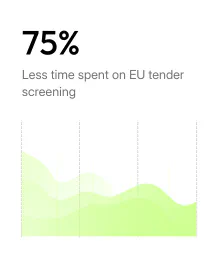

* Internal benchmark tests (July 2025) show that an experienced analyst needs about 15 minutes¹ to perform the first-pass qualification of a typical EU tender. With TENDERBOT IO, that same analyst can pre-qualify roughly 150 tenders in the same 15 minutes — around 10 tenders in ± 1 minute. This represents a reduction in screening time of well over 90 %. To stay conservative and cover variations in document length and working style, we therefore communicate “up to 75% time savings.
¹ Calculation assumes an average reading speed of ~2 minutes per A4 page and an average tender length of ~7 pages.