Dec 18, 2025
From Reactive to Proactive: How Smart Tools Find Tenders Before Your Competitors Do
Most companies approach public tenders reactively — they wait for opportunities to appear, then scramble to prepare a response. By the time a potential contract surfaces, competitors are often already preparing their bids.
Modern procurement intelligence changes that dynamic. With the right data tools, organizations can move from reactive tender chasing to proactive opportunity discovery, identifying relevant projects long before they’re officially published.
1. The Reactive Reality of Traditional Tendering
In most organizations, tender discovery still looks like this:
- Team members manually check national portals or TED daily.
- Opportunities are found late in the process, leaving little time for quality proposals.
- Important tenders are missed because search filters were too narrow (or too broad).
- Staff waste hours scrolling through irrelevant notices.
This reactive approach leads to stress, rushed submissions, and inconsistent win rates.
❌ Symptom of reactivity: “We always find out about tenders when it’s already too late.”
2. What “Proactive Tendering” Really Means
Proactive tendering isn’t about speed alone — it’s about anticipation and relevance.
It means identifying opportunities that fit your company’s capability profile as soon as they appear, and sometimes even before formal publication.
A proactive tender discovery strategy includes:
- Monitoring upcoming framework renewals and expiring contracts.
- Tracking procurement authority behavior and budget cycles.
- Following recurring CPV codes or keywords across jurisdictions.
- Receiving alerts the moment new tenders match predefined business rules.
This gives your business a head start — time to qualify, prepare partners, and develop a winning strategy before others react.
3. The Competitive Edge of Early Discovery
Early awareness of tenders enables:
- Better resource planning – allocate technical experts and proposal teams earlier.
- Higher quality submissions – more time for documentation, compliance, and design.
- Strategic alignment – focus only on projects that fit your capacity and goals.
- Partner readiness – coordinate consortiums and subcontractors proactively.
📈 Companies that consistently identify tenders early report up to 30% higher win rates due to improved bid preparation quality.
4. How Smart Tools Enable Proactive Discovery
Advanced tender monitoring platforms (like Tenderbot.io) transform scattered procurement data into actionable insights.
Here’s how modern discovery works:
| Function | Description | Value |
|---|---|---|
| Automated Data Aggregation | Collects and consolidates notices from hundreds of EU and national sources. | Eliminates manual portal checks. |
| Keyword & CPV Mapping | Matches tenders to your products, services, and NAICS/CPV codes. | Improves relevance of alerts. |
| Pre-Qualification Filters | Screens tenders based on company-specific criteria (value range, geography, industry). | Saves time by excluding unfit projects. |
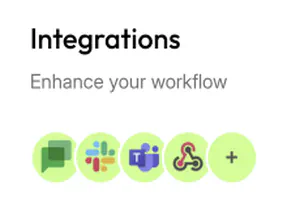
| Webhook & Integration Support | Sends matches directly to CRMs, Slack, or Teams. | Keeps teams aligned and responsive. |
| Historical Trend Analysis | Tracks when authorities publish or renew frameworks. | Enables predictive tender planning. |
💡 Example: If your company installs solar infrastructure, you can track municipalities whose renewable-energy contracts are due for renewal in the next quarter — giving you months of lead time to prepare.
5. Moving from Data to Intelligence
Access to tender data is only the first step.
What sets proactive organizations apart is how they interpret and act on it.
- Analyze past award data to understand buyer preferences.
- Use cross-sector filters to identify diversification opportunities.
- Build internal dashboards for performance tracking and decision support.
- Continuously refine your company’s capability profile to improve match accuracy.
Proactivity isn’t just about tools — it’s about embedding data-driven processes into your tendering strategy.
6. Shifting Your Organization’s Mindset
Transitioning from reactive to proactive requires a cultural shift:
- Define ownership: Assign a dedicated role for opportunity monitoring.
- Automate discovery: Let systems handle the scanning; focus human effort on evaluation.
- Review regularly: Weekly tender pipeline reviews keep teams focused on qualified leads.
- Reward foresight: Recognize staff who identify early opportunities or strategic fits.
⚙️ Think of proactive tendering as sales pipeline management for public contracts — structured, measurable, and continuous.
Conclusion
Public procurement rewards preparation.
Organizations that see tenders early — and prepare strategically — consistently outperform those that rely on last-minute reactions.
Smart tender discovery tools like Tenderbot.io empower your team to:
- Find tenders the moment they appear,
- Focus on those aligned with your business, and
- Build higher-quality, better-timed bids.
Move from reacting to opportunities to creating them — and stay a step ahead of your competitors in every tender cycle.
Related Blogs
See All Blogs


Streamline EU Tendering
Automate discovery and evaluation of public contracts, so you focus on bids that truly fit.
Begin Your Free TrialEU, EEA & Switzerland

Austria

Belgium

Bulgaria

Croatia

Cyprus

Czech Republic

Denmark

Estonia
Austria
Belgium
Bulgaria
Croatia
Cyprus
Czech Republic
Denmark
Estonia

Finland

France

Germany

Greece

Hungary

Ireland

Italy

Latvia
Finland
France
Germany
Greece
Hungary
Ireland
Italy
Latvia

Lithuania

Luxembourg

Malta

Netherlands

Poland

Portugal

Romania

Slovakia
Lithuania
Luxembourg
Malta
Netherlands
Poland
Portugal
Romania
Slovakia

Slovenia

Spain

Sweden

Iceland

Liechtenstein

Norway

Switzerland
Slovenia
Spain
Sweden
Iceland
Liechtenstein
Norway
Switzerland
Serving all European Union, European Economic Area countries and Switzerland.
EU Buyer Reach

Tender Bot tracks every public buyer across Europe and funnels the most relevant.
Save Time and Make Better Tender Decisions
Focus on the tenders that matter—Tender Bot automatically screens EU-wide public opportunities, ranks them against your capabilities, and delivers a shortlist you can act on. Spend less time sifting through notices and more time crafting winning proposals.
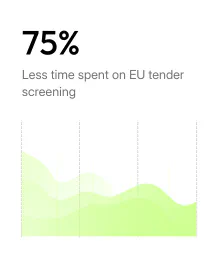

* Internal benchmark tests (July 2025) show that an experienced analyst needs about 15 minutes¹ to perform the first-pass qualification of a typical EU tender. With TENDERBOT IO, that same analyst can pre-qualify roughly 150 tenders in the same 15 minutes — around 10 tenders in ± 1 minute. This represents a reduction in screening time of well over 90 %. To stay conservative and cover variations in document length and working style, we therefore communicate “up to 75% time savings.
¹ Calculation assumes an average reading speed of ~2 minutes per A4 page and an average tender length of ~7 pages.