Dec 11, 2025
Sector Focus: How Public Procurement Works in Sectors Like Construction, IT, Renewable Energy, and Health

Public procurement isn’t one-size-fits-all. While the legal framework is harmonized across the EU, each sector operates with its own dynamics, evaluation criteria, and compliance nuances.
Understanding these differences can help your company target the right opportunities, prepare better bids, and allocate resources more effectively.
1. Construction & Infrastructure
Market Overview
The construction sector represents the largest share of public spending in Europe, covering projects such as transportation infrastructure, public buildings, and utilities.
It’s a competitive environment with strict qualification requirements.
Key Characteristics
- Evaluation focus: Price, technical capability, safety records, and environmental management (e.g., waste handling).
- Common criteria: Financial capacity, previous works of similar scale, quality assurance systems (ISO 9001 / 14001).
- Procurement form: Works contracts or design-and-build agreements.
- Complexity level: High — often involves joint ventures or consortiums.
Compliance Essentials
- Proof of construction insurance and certifications (e.g., CE marking).
- Compliance with local labor laws and environmental regulations.
- Detailed project timelines and resource allocation plans.
🏗️ Tip: Construction tenders often require site visits — factor travel and logistics into your bidding schedule.
2. Information Technology (IT & Digital Services)
Market Overview
Governments increasingly rely on IT systems for digital transformation — from cloud infrastructure to cybersecurity and public databases.
The demand for flexibility, innovation, and data protection compliance drives procurement in this field.
Key Characteristics
- Evaluation focus: Technical quality, scalability, data security, and lifecycle costs (not just upfront price).
- Procurement form: Framework agreements, dynamic purchasing systems (DPS), or service contracts.
- Typical buyers: Ministries, health authorities, educational institutions, and municipalities.
Compliance Essentials
- GDPR compliance and data residency documentation.
- ISO/IEC 27001 or equivalent information security certifications.
- Demonstrated capacity for long-term maintenance and support.
💻 Tip: IT tenders often allow consortiums with specialized partners (e.g., software, hosting, and integration firms) — leverage partnerships to broaden eligibility.
3. Renewable Energy & Environmental Projects
Market Overview
Sustainability and climate neutrality targets are reshaping public procurement across Europe.
Renewable energy tenders (solar, wind, bioenergy) and environmental services (waste, water, emissions control) are fast-growing segments supported by EU funding programs.
Key Characteristics
- Evaluation focus: Environmental impact, innovation, technical feasibility, and contribution to sustainability goals.
- Procurement form: Supply and works contracts, often tied to performance-based financing.
- Typical buyers: Energy agencies, municipalities, and infrastructure funds.
Compliance Essentials
- Environmental impact assessments and permits.
- Certificates of renewable energy origin.
- ESG (Environmental, Social, Governance) compliance documentation.
🌱 Tip: Sustainability criteria now carry significant scoring weight — even in non-environmental tenders. Demonstrate your green credentials wherever possible.
4. Healthcare & Medical Procurement
Market Overview
Healthcare is one of the most regulated and sensitive sectors in EU public procurement.
It includes everything from pharmaceuticals and equipment to digital health solutions and hospital management systems.
Key Characteristics
- Evaluation focus: Compliance with health regulations, product safety, and supplier reliability.
- Procurement form: Supply contracts or framework agreements with multiple lots (equipment, maintenance, logistics).
- Typical buyers: Hospitals, ministries of health, insurance funds, and regional health authorities.
Compliance Essentials
- CE marking and conformity with Medical Device Regulation (MDR 2017/745).
- GMP (Good Manufacturing Practice) or ISO 13485 certification for suppliers.
- Traceability and product recall procedures.
⚕️ Tip: Healthcare tenders often require rapid delivery and guaranteed supply continuity — highlight logistics and service support capabilities in your proposal.
5. Cross-Sector Lessons
Despite their differences, successful bidders in all sectors share these traits:
- A clear understanding of qualification thresholds and documentation requirements.
- The ability to demonstrate past performance with measurable results.
- Strong internal processes for bid/no-bid decisions and document control.
- Early identification of relevant opportunities — often the biggest competitive advantage.
6. Finding Relevant Tenders Efficiently
Searching across multiple national portals for sector-specific tenders is time-consuming.
Platforms like Tenderbot.io aggregate and categorize public procurement notices across Europe, using company-specific filters such as:
- Sector focus (e.g., CPV codes for Construction, IT, Health, or Energy)
- Geographical scope
- Contract value thresholds
- Qualification criteria
This ensures that your team spends less time searching and more time preparing winning proposals.
Conclusion
Understanding how public procurement differs by sector helps your company tailor bids, comply with regulations, and build a stronger tendering strategy.
From infrastructure to IT and renewable energy, every sector has its own rhythm and compliance landscape — but the opportunities are immense for suppliers that prepare strategically.
Tenderbot.io streamlines your path to these opportunities by automating the discovery and pre-qualification process, helping you stay ahead in the public procurement race.
Related Blogs
See All Blogs


Streamline EU Tendering
Automate discovery and evaluation of public contracts, so you focus on bids that truly fit.
Begin Your Free TrialEU, EEA & Switzerland

Austria

Belgium
Bulgaria
Croatia
Cyprus
Czech Republic
Denmark

Estonia
Austria
Belgium
Bulgaria
Croatia
Cyprus
Czech Republic
Denmark
Estonia

Finland
France

Germany

Greece

Hungary
Ireland
Italy

Latvia
Finland
France
Germany
Greece
Hungary
Ireland
Italy
Latvia

Lithuania

Luxembourg
Malta
Netherlands

Poland

Portugal

Romania
Slovakia
Lithuania
Luxembourg
Malta
Netherlands
Poland
Portugal
Romania
Slovakia
Slovenia
Spain
Sweden

Iceland
Liechtenstein
Norway

Switzerland
Slovenia
Spain
Sweden
Iceland
Liechtenstein
Norway
Switzerland
Serving all European Union, European Economic Area countries and Switzerland.
EU Buyer Reach

Tender Bot tracks every public buyer across Europe and funnels the most relevant.
Save Time and Make Better Tender Decisions
Focus on the tenders that matter—Tender Bot automatically screens EU-wide public opportunities, ranks them against your capabilities, and delivers a shortlist you can act on. Spend less time sifting through notices and more time crafting winning proposals.
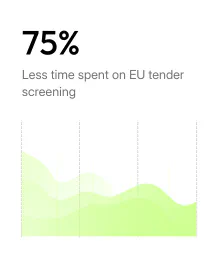
* Internal benchmark tests (July 2025) show that an experienced analyst needs about 15 minutes¹ to perform the first-pass qualification of a typical EU tender. With TENDERBOT IO, that same analyst can pre-qualify roughly 150 tenders in the same 15 minutes — around 10 tenders in ± 1 minute. This represents a reduction in screening time of well over 90 %. To stay conservative and cover variations in document length and working style, we therefore communicate “up to 75% time savings.
¹ Calculation assumes an average reading speed of ~2 minutes per A4 page and an average tender length of ~7 pages.