Jan 01, 2026
The ROI of Tender Automation: Calculating the True Value of Streamlined Discovery

When companies consider automating tender discovery, one question inevitably arises:
“What’s the real return on investment?”
While automation sounds efficient, many underestimate just how measurable — and immediate — the gains can be.
This article explains how to calculate the ROI of tender automation by looking at time saved, opportunities gained, and operational value created.
1. Understanding the Tendering Cost Baseline
Before calculating ROI, you need a clear baseline — the total cost of your current (mostly manual) tender process.
Typical cost components include:
- Labor hours spent searching and screening tenders
- Duplicate work across teams or regions
- Missed opportunities due to late discovery
- Administrative overhead (manual reporting, documentation)
🧾 Baseline Formula:
Total Manual Cost = (Hours per week × Hourly rate × Employees involved) + Lost opportunity value
For most mid-sized companies, this easily exceeds €2,000–€5,000 per month in direct and indirect costs.
2. The Three Dimensions of Tender Automation ROI
A. Time Savings
Automated tender discovery eliminates repetitive search and classification tasks.
| Activity | Manual Effort | Automated Effort | Gain |
|---|---|---|---|
| Searching portals | 10–15 hrs/week | 0 hrs | +10–15 hrs |
| Reading & classifying notices | 5 hrs/week | 1 hr (review only) | +4 hrs |
| Team coordination | 3 hrs/week | <1 hr | +2 hrs |
⏱️ Result: Up to 75% time savings per user — time that can be redirected to proposal quality and client work.
B. Opportunity Gain
Automation increases visibility and relevance — you simply find more tenders that fit your criteria.
| Metric | Manual | Automated | Improvement |
|---|---|---|---|
| Relevant tenders found/month | 20 | 35 | +75% |
| Missed tenders (due to late or no discovery) | 10 | 2 | -80% |
| Average time before deadline | 3 days | 7 days | +130% lead time |
📈 Early discovery means more preparation time and higher success rates.
C. Quality & Strategic Value
Beyond numbers, automation improves decision quality:
- Teams focus only on qualified opportunities.
- Tender data becomes structured and searchable.
- Leadership gains visibility into pipeline health and forecast accuracy.
🎯 When management sees reliable data, tendering shifts from guesswork to a strategic business function.
3. Calculating Your ROI Step-by-Step
Use this simple model:
ROI = (Annual Savings + Opportunity Value Gained – Automation Cost) ÷ Automation Cost × 100
Example:
| Scenario | Assumptions | Annual Value (€) |
|---|---|---|
| Time savings | 1 FTE × €30/h × 500 hrs saved | 15,000 |
| Additional opportunities (Conservative) | 1 extra win × €150,000 contract × 8% margin | 12,000 |
| Additional opportunities (Optimistic) | 2 extra wins × €200,000 contract × 10% margin | 40,000 |
| Tenderbot.io subscription (annual) | — | 360 |
ROI Calculations
| Case | Formula | ROI (%) |
|---|---|---|
| Conservative | (15,000 + 12,000 – 360) / 360 × 100 | ≈ 7,370% |
| Optimistic | (15,000 + 40,000 – 360) / 360 × 100 | ≈ 15,122% |
Explanation
- Time savings: Based on one full-time equivalent saving ~500 hours annually at €30/hour.
- Additional wins: Conservative assumes one tender per year worth €150k at 8% profit; Optimistic assumes two tenders at €200k and 10%.
- Profit vs. revenue: ROI focuses on net profit gains, not total contract turnover.
- Subscription cost: Tenderbot.io’s annual fee is around €360.
Even under conservative conditions, the annual ROI exceeds 7,000%, while the optimistic case shows potential returns over 15,000% — illustrating how automating tender discovery delivers disproportionate value relative to its cost.
💰 ROI (Conservative) ≈ 7,400% — meaning every euro invested in automation returns roughly €74 in measurable value.
4. Hidden Benefits Often Missed
Automation delivers several qualitative advantages that go beyond financial ROI:
- Reduced stress: Teams no longer chase deadlines last-minute.
- Improved collaboration: Centralized alerts and integrations with Slack, Teams, or CRMs.
- Knowledge retention: Tender history and intelligence stay within the organization.
- Reputation boost: Faster, higher-quality responses strengthen your standing with public buyers.
These benefits compound over time, improving both performance and employee satisfaction.
5. Measuring and Communicating Results
To maintain momentum, define clear KPIs for your tender automation journey:
- Tenders discovered per month
- Win rate improvement (%)
- Average time from publication to detection
- Average time from detection to decision
- Labor hours saved per bid cycle
Share quarterly reports with leadership to demonstrate continuous value and secure future investment.
6. From Cost Center to Growth Engine
Public tendering used to be treated as an administrative cost — a necessity of doing business.
With automation, it becomes a strategic growth channel supported by measurable data.
Organizations that modernize their discovery process with platforms like Tenderbot.io consistently report:
- Faster access to qualified tenders
- Lower operating costs
- Improved win ratios
- Scalable visibility across regions and industries
Conclusion
Tender automation is not about replacing people — it’s about empowering them.
By eliminating low-value manual work, your team can focus on strategy, relationships, and winning proposals.
When you can measure your results in saved hours, higher win rates, and faster discovery, the question isn’t “Should we automate?”
It’s “How much value are we losing every day we don’t?”
Start measuring your ROI today — and see how Tenderbot.io can multiply it.
Related Blogs
See All Blogs


Streamline EU Tendering
Automate discovery and evaluation of public contracts, so you focus on bids that truly fit.
Begin Your Free TrialEU, EEA & Switzerland

Austria

Belgium

Bulgaria

Croatia

Cyprus

Czech Republic

Denmark

Estonia
Austria
Belgium
Bulgaria
Croatia
Cyprus
Czech Republic
Denmark
Estonia

Finland

France

Germany

Greece

Hungary

Ireland

Italy

Latvia
Finland
France
Germany
Greece
Hungary
Ireland
Italy
Latvia

Lithuania

Luxembourg

Malta

Netherlands

Poland

Portugal

Romania

Slovakia
Lithuania
Luxembourg
Malta
Netherlands
Poland
Portugal
Romania
Slovakia

Slovenia

Spain

Sweden

Iceland

Liechtenstein

Norway

Switzerland
Slovenia
Spain
Sweden
Iceland
Liechtenstein
Norway
Switzerland
Serving all European Union, European Economic Area countries and Switzerland.
EU Buyer Reach

Tender Bot tracks every public buyer across Europe and funnels the most relevant.
Save Time and Make Better Tender Decisions
Focus on the tenders that matter—Tender Bot automatically screens EU-wide public opportunities, ranks them against your capabilities, and delivers a shortlist you can act on. Spend less time sifting through notices and more time crafting winning proposals.
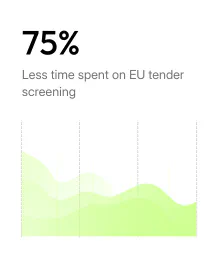

* Internal benchmark tests (July 2025) show that an experienced analyst needs about 15 minutes¹ to perform the first-pass qualification of a typical EU tender. With TENDERBOT IO, that same analyst can pre-qualify roughly 150 tenders in the same 15 minutes — around 10 tenders in ± 1 minute. This represents a reduction in screening time of well over 90 %. To stay conservative and cover variations in document length and working style, we therefore communicate “up to 75% time savings.
¹ Calculation assumes an average reading speed of ~2 minutes per A4 page and an average tender length of ~7 pages.