Nov 20, 2025
Estimating the True Cost of Tender Bidding: Hidden Costs & Budget Planning

Winning public tenders requires more than great pricing — it demands a clear understanding of the real cost of bidding. Many companies underestimate the hidden expenses of preparing proposals, which can affect profitability and resource allocation.
This guide helps you identify all cost components and plan a realistic tendering budget.
1. Why Tender Costing Matters
Tendering isn’t free.
Each submission can consume dozens of staff hours, management attention, and external resources.
By tracking costs early, companies can make better “bid / no-bid” decisions and focus on opportunities that are financially worthwhile.
2. Direct Costs
Direct costs are easily measurable and directly linked to a specific tender.
Typical examples:
- Staff hours for proposal writing, pricing, design, and review
- Printing, binding, and document translation costs
- Travel or site visit expenses (mandatory briefings, inspections)
- External consultants, legal reviews, or tender advisory fees
💡 Pro Tip: Track direct costs per role (project manager, engineer, legal) to identify where most effort is spent.
3. Indirect (Hidden) Costs
Indirect costs are often overlooked but can significantly impact ROI.
Examples include:
- Opportunity cost — time spent bidding means less time on delivery or sales
- Overtime or capacity shortages in other projects
- System and tool subscriptions (CRM, compliance databases, templates)
- Stress-related inefficiency and context-switching
Rule of thumb:
If your team is running multiple tenders simultaneously, hidden costs can exceed direct expenses by 30–50%.
4. How to Calculate Your Bid Budget
A practical approach:
- Estimate staff hours required for each role
- Apply internal hourly rates (including overhead)
- Add third-party costs (consultants, translations, certifications)
- Include a buffer (10–15%) for revisions or clarifications
| Role / Resource | Estimated Hours | Cost Rate | Subtotal |
|---|---|---|---|
| Bid Manager | 20 | €60 | €1,200 |
| Technical Expert | 15 | €75 | €1,125 |
| Legal Review | 5 | €100 | €500 |
| Admin Support | 10 | €35 | €350 |
| Total | €3,175 |
5. Budget Planning Tips
- Create a standard bid costing template to keep consistency.
- Record actual vs. planned effort after submission — this builds historical accuracy.
- Review your “cost per win” ratio every quarter to refine resource allocation.
- Prioritize tenders with high strategic or long-term value, not just immediate revenue.
6. Deciding When Not to Bid
It’s equally strategic to say no.
Skip opportunities where:
- The scope doesn’t align with your core capabilities
- The estimated cost outweighs potential margin
- Requirements suggest a preferred incumbent supplier
❌ A disciplined “no-bid” saves more money than any last-minute proposal rush.
Conclusion
Understanding and managing the true cost of tendering protects margins and keeps your team focused on the right tenders. Use structured cost tracking and planning templates to bring transparency to your bid pipeline.
And when you’re ready to optimize how you discover tenders worth bidding on, Tenderbot.io helps you identify and pre-qualify relevant public tenders before you invest your resources.
Related Blogs
See All Blogs


Streamline EU Tendering
Automate discovery and evaluation of public contracts, so you focus on bids that truly fit.
Begin Your Free TrialEU, EEA & Switzerland

Austria

Belgium

Bulgaria

Croatia

Cyprus

Czech Republic

Denmark

Estonia
Austria
Belgium
Bulgaria
Croatia
Cyprus
Czech Republic
Denmark
Estonia

Finland

France

Germany

Greece

Hungary

Ireland

Italy

Latvia
Finland
France
Germany
Greece
Hungary
Ireland
Italy
Latvia

Lithuania

Luxembourg

Malta

Netherlands

Poland

Portugal

Romania

Slovakia
Lithuania
Luxembourg
Malta
Netherlands
Poland
Portugal
Romania
Slovakia

Slovenia

Spain

Sweden

Iceland

Liechtenstein

Norway

Switzerland
Slovenia
Spain
Sweden
Iceland
Liechtenstein
Norway
Switzerland
Serving all European Union, European Economic Area countries and Switzerland.
EU Buyer Reach

Tender Bot tracks every public buyer across Europe and funnels the most relevant.
Save Time and Make Better Tender Decisions
Focus on the tenders that matter—Tender Bot automatically screens EU-wide public opportunities, ranks them against your capabilities, and delivers a shortlist you can act on. Spend less time sifting through notices and more time crafting winning proposals.
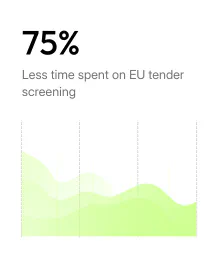

* Internal benchmark tests (July 2025) show that an experienced analyst needs about 15 minutes¹ to perform the first-pass qualification of a typical EU tender. With TENDERBOT IO, that same analyst can pre-qualify roughly 150 tenders in the same 15 minutes — around 10 tenders in ± 1 minute. This represents a reduction in screening time of well over 90 %. To stay conservative and cover variations in document length and working style, we therefore communicate “up to 75% time savings.
¹ Calculation assumes an average reading speed of ~2 minutes per A4 page and an average tender length of ~7 pages.