Nov 27, 2025
Team Collaboration in Tender Response Projects: Roles, Responsibilities & Workflow Best Practices

Responding to public tenders is a complex process — it’s not just about writing a proposal but managing a coordinated effort across departments.
Strong internal collaboration can be the difference between a winning bid and a missed deadline.
1. Why Collaboration Matters in Tendering
Tender responses often involve technical, legal, financial, and project management inputs.
Without a clear workflow, even skilled teams struggle with version control, conflicting edits, and lost accountability.
A structured collaboration model streamlines effort, improves quality, and ensures compliance.
2. Core Roles in a Tender Response Team
| Role | Primary Responsibilities |
|---|---|
| Bid Manager / Coordinator | Oversees the entire process, sets deadlines, and ensures compliance with submission rules. |
| Technical Lead | Provides content for specifications, deliverables, and implementation plans. |
| Finance / Pricing Expert | Prepares cost breakdowns, verifies margins, and ensures consistency across documents. |
| Legal Advisor | Checks contract terms, compliance requirements, and risk clauses. |
| Marketing / Communications | Formats and proofreads the final submission for clarity and visual consistency. |
| Executives / Approvers | Give final sign-off and authorization to submit. |
💡 Keep your team small but multidisciplinary — 4–6 core members is ideal for most organizations.
3. Establish a Clear Workflow
- Kick-off Meeting: Define scope, deadlines, and responsibilities.
- Document Repository: Centralize all templates, references, and prior bids.
- Version Control: Use structured naming (e.g.,
V1_technical,V2_final_approved). - Internal Reviews: Schedule at least one mid-review and one final review.
- Submission Check: Confirm signatures, attachments, and portal uploads 24h before deadline.
🧭 Use cloud-based collaboration platforms (SharePoint, Confluence, or internal portals) to keep everyone aligned.
4. Communication Best Practices
- Set up a dedicated channel (e.g., Slack, Teams, or email group).
- Keep all decisions and clarifications in writing for traceability.
- Define escalation paths for critical questions.
- Avoid simultaneous edits in different versions — assign clear ownership per section.
5. Common Collaboration Challenges
| Challenge | Solution |
|---|---|
| Last-minute edits from multiple people | Lock documents 24h before submission |
| Missing approvals | Use a checklist with sign-off dates |
| Overlapping responsibilities | Clarify ownership in the kick-off phase |
| Disconnected tools | Integrate your tender monitoring and documentation systems |
6. Continuous Improvement
After every tender, conduct a post-submission review:
- What went well?
- Where did bottlenecks occur?
- Which resources were over or under-allocated?
Maintain a living “lessons learned” document — it’s your best long-term efficiency driver.
Conclusion
A coordinated team with defined roles and workflows turns the tendering process from chaos into an organized, repeatable operation. Even without automation, disciplined collaboration can improve bid quality and consistency dramatically.
And when your team is ready to spend more time on high-value tenders instead of manual searching, Tenderbot.io helps identify pre-qualified tenders so your team can focus on what matters most — writing winning proposals.
Related Blogs
See All Blogs


Streamline EU Tendering
Automate discovery and evaluation of public contracts, so you focus on bids that truly fit.
Begin Your Free TrialEU, EEA & Switzerland

Austria

Belgium

Bulgaria

Croatia

Cyprus

Czech Republic

Denmark

Estonia
Austria
Belgium
Bulgaria
Croatia
Cyprus
Czech Republic
Denmark
Estonia

Finland

France

Germany

Greece

Hungary

Ireland

Italy

Latvia
Finland
France
Germany
Greece
Hungary
Ireland
Italy
Latvia

Lithuania

Luxembourg

Malta

Netherlands

Poland

Portugal

Romania

Slovakia
Lithuania
Luxembourg
Malta
Netherlands
Poland
Portugal
Romania
Slovakia

Slovenia

Spain

Sweden

Iceland

Liechtenstein

Norway

Switzerland
Slovenia
Spain
Sweden
Iceland
Liechtenstein
Norway
Switzerland
Serving all European Union, European Economic Area countries and Switzerland.
EU Buyer Reach

Tender Bot tracks every public buyer across Europe and funnels the most relevant.
Save Time and Make Better Tender Decisions
Focus on the tenders that matter—Tender Bot automatically screens EU-wide public opportunities, ranks them against your capabilities, and delivers a shortlist you can act on. Spend less time sifting through notices and more time crafting winning proposals.
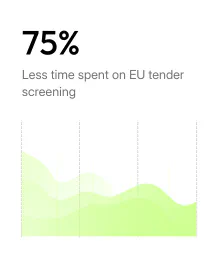

* Internal benchmark tests (July 2025) show that an experienced analyst needs about 15 minutes¹ to perform the first-pass qualification of a typical EU tender. With TENDERBOT IO, that same analyst can pre-qualify roughly 150 tenders in the same 15 minutes — around 10 tenders in ± 1 minute. This represents a reduction in screening time of well over 90 %. To stay conservative and cover variations in document length and working style, we therefore communicate “up to 75% time savings.
¹ Calculation assumes an average reading speed of ~2 minutes per A4 page and an average tender length of ~7 pages.