sij 15, 2026
Procurement 4.0: Što znači za mala i srednja poduzeća

The term “Procurement 4.0” describes the digital transformation of procurement — a shift from manual, document-heavy processes to intelligent, data-driven, and fully connected systems.
While large corporations have been pursuing this change for years, the real opportunity now lies with small and mid-sized enterprises (SMEs) that want to compete effectively in the public sector.
This article explores what Procurement 4.0 means in practice and how SMEs can benefit from the transformation.
1. From Paper to Platforms: The Evolution of Procurement
Public procurement has moved through several generations:
| Stage | Description | Typical Characteristics |
|---|---|---|
| Procurement 1.0 | Manual, paper-based processes | Physical documentation, slow approvals |
| Procurement 2.0 | Digital document management | Electronic tenders, PDFs, portals |
| Procurement 3.0 | Centralized e-procurement systems | Standardized formats, transparency rules |
| Procurement 4.0 | Intelligent, automated, data-driven systems | AI discovery, predictive analytics, integrated platforms |
Procurement 4.0 doesn’t replace people — it connects systems, data, and decisions to make procurement more transparent, efficient, and strategic.
2. What Procurement 4.0 Means for SMEs
For SMEs, Procurement 4.0 offers a level playing field that was once difficult to achieve.
It removes many traditional barriers — information asymmetry, complex documentation, and slow response cycles.
Key advantages:
- Earlier access to opportunities: Automated tools identify relevant tenders faster.
- Reduced administrative load: Data reuse and structured templates simplify participation.
- Smarter decision-making: Insights into historical awards and market trends support better bid/no-bid calls.
- Cross-border visibility: European platforms make international tenders easier to access and understand.
🌍 In short: Procurement 4.0 enables SMEs to act with the scale and agility of larger competitors — without increasing headcount.
3. The Four Pillars of Procurement 4.0
1. Data Integration
Procurement is no longer isolated; systems now connect suppliers, buyers, and public databases.
For SMEs, this means simpler onboarding and visibility across multiple markets.
2. Process Automation
Routine activities such as tender searches, classification, and documentation are automated — saving valuable time and reducing errors.
3. Predictive Intelligence
Analytics tools can forecast upcoming opportunities by monitoring contract renewals, funding cycles, and buyer behavior.
4. Collaboration & Transparency
Digital ecosystems make supplier data visible, comparable, and auditable — improving trust and reducing corruption risk.
⚙️ Together, these elements allow SMEs to focus on strategy and execution, not manual administration.
4. Overcoming Common SME Challenges
Despite the opportunities, SMEs often face practical barriers in adopting digital procurement tools:
| Challenge | Description | Solution |
|---|---|---|
| Limited resources | Smaller teams cannot afford time-consuming tender monitoring. | Use automated discovery platforms like Tenderbot.io to pre-qualify opportunities. |
| Complex procedures | Different countries and authorities follow varying formats. | Rely on standardized data aggregation and CPV-based matching. |
| Low visibility | Hard to know which tenders are truly relevant. | Filter opportunities by company-specific capability criteria. |
| Short deadlines | Late discovery leads to rushed submissions. | Set up proactive notifications for new tenders as they are published. |
By removing these barriers, SMEs can participate in more tenders — and compete on quality rather than reaction time.
5. The Role of AI and Automation in Procurement 4.0
AI isn’t about replacing human decision-making.
In the context of Procurement 4.0, it supports three core functions:
- Discovery: Continuously scanning and identifying new tenders across jurisdictions.
- Qualification: Filtering based on company size, service scope, and prior experience.
- Insight: Providing analytics on buyer behavior, contract timing, and historical trends.
🔍 Tools like Tenderbot.io enable SMEs to focus on tenders they can realistically win, instead of wasting time on irrelevant searches.
6. Building a Digital Procurement Mindset
Procurement 4.0 isn’t achieved by technology alone — it requires a mindset shift:
- View tendering as a strategic growth activity, not an administrative task.
- Invest in data quality — ensure your capability profile and references are accurate and structured.
- Encourage cross-functional collaboration between sales, operations, and compliance teams.
- Treat automation as an assistant, not an authority — it amplifies expertise, it doesn’t replace it.
💡 The most successful SMEs see digital procurement not as a cost, but as an enabler of scale and competitiveness.
7. How Tenderbot.io Supports SMEs in the Procurement 4.0 Era
Tenderbot.io helps SMEs embrace Procurement 4.0 principles without requiring large IT budgets or internal data teams.
The platform:
- Aggregates public tenders across EU and national sources
- Applies AI-driven filters to pre-qualify tenders based on company-specific criteria
- Delivers relevant opportunities directly to users
- Operates transparently and securely within EU data protection standards
By automating tender discovery and pre-qualification, Tenderbot.io allows SMEs to focus their limited resources on winning — not searching.
Conclusion
Procurement 4.0 represents a new era of opportunity for small and mid-sized enterprises.
Digitalization and automation make public procurement faster, fairer, and more accessible — if approached strategically.
By adopting intelligent, transparent tools and building a data-driven mindset, SMEs can not only keep up with larger competitors but often outperform them in agility and responsiveness.
The future of procurement isn’t just digital — it’s smart, inclusive, and opportunity-driven.
And for SMEs ready to take that step, Tenderbot.io is the ideal starting point.
Povezani blogovi
Pogledaj sve blogove


Optimizirajte EU javnu nabavu
Automatizirajte otkrivanje i evaluaciju javnih ugovora, tako da se fokusirate na ponude koje stvarno odgovaraju.
Započnite svoju besplatnu probuEU, EEA i Švicarska

Austrija

Belgija

Bugarska

Hrvatska
Cyprus

Češka Republika

Danska

Estonija
Austrija
Belgija
Bugarska
Hrvatska
Cyprus
Češka Republika
Danska
Estonija

Finska

Francuska

Njemačka

Grčka

Mađarska

Irska

Italija

Latvija
Finska
Francuska
Njemačka
Grčka
Mađarska
Irska
Italija
Latvija

Litvanija

Luxemburg

Malta

Nizozemska

Poljska

Portugal

Rumunija

Slovačka
Litvanija
Luxemburg
Malta
Nizozemska
Poljska
Portugal
Rumunija
Slovačka

Slovenija

Španjolska

Švedska

Island

Lihtenštajn

Norveška

Švicarska
Slovenija
Španjolska
Švedska
Island
Lihtenštajn
Norveška
Švicarska
Pokrivamo sve zemlje Europske unije, Europskog gospodarskog prostora i Švicarsku.
Doseg EU kupaca

Tender Bot prati svakog javnog kupca u Europi i usmjerava najrelevantnije.
Uštedite vrijeme i donosite bolje odluke o natječajima
Usredotočite se na natječaje koji su važni—Tender Bot automatski pregledava javne prilike širom EU, rangira ih prema vašim sposobnostima i isporučuje kratki popis na kojem možete djelovati. Provedite manje vremena pregledavajući obavijesti i više vremena stvarajući pobjedničke prijedloge.
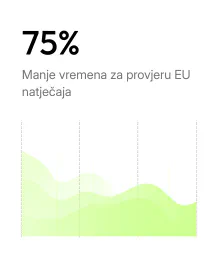

* Interni benchmark testovi (srpanj 2025.) pokazuju da iskusnom analitičaru treba oko 15 minuta¹ za obavljanje prvog kvalificiranja tipičnog EU natječaja. S TENDERBOT IO, taj isti analitičar može unaprijed kvalificirati otprilike 150 natječaja u istih 15 minuta — oko 10 natječaja u ± 1 minuti. To predstavlja smanjenje vremena pregleda od više od 90 %. Da bismo ostali konzervativni i pokrili varijacije u duljini dokumenata i radnom stilu, stoga komuniciramo “do 75% uštede vremena.
¹ Izračun pretpostavlja prosječnu brzinu čitanja od ~2 minute po A4 stranici i prosječnu duljinu natječaja od ~7 stranica.