jan. 08, 2026
A ética e os riscos da IA na contratação pública

Artificial Intelligence (AI) is transforming how governments plan, evaluate, and manage procurement. It promises efficiency, transparency, and faster decision-making — but it also introduces new ethical and operational risks that public institutions must address carefully.
As AI tools become more embedded in procurement processes, balancing innovation with accountability becomes a central governance challenge.
1. Why Ethics Matter in Public Procurement
Government procurement is not just about transactions — it’s about trust, fairness, and the responsible use of public funds. Introducing AI without strong ethical frameworks can jeopardize those principles.
Key concerns include:
- Ensuring equal access for all suppliers
- Avoiding bias in evaluation or tender matching
- Protecting sensitive commercial and personal data
- Maintaining transparency in decision-making
⚖️ Ethical procurement is not anti-technology — it’s about using technology responsibly, with human oversight and public accountability.
2. The Main Ethical Risks of AI in Procurement
| Risk Category | Description | Example |
|---|---|---|
| Algorithmic Bias | AI systems trained on incomplete or biased data can unintentionally favor certain types of suppliers. | A matching algorithm over-prioritizes large companies because past awards mostly went to them. |
| Opacity (“Black Box” Decisions) | AI-driven recommendations are difficult to audit or explain. | A system excludes tenders without clear reasoning traceable by officials. |
| Data Privacy & Sovereignty | Sensitive procurement data may be stored or processed outside compliant jurisdictions. | Supplier information hosted on non-EU servers violates GDPR principles. |
| Over-Automation | Excessive reliance on algorithms may erode human judgment. | Procurement officers accept AI scores without reviewing context or exceptions. |
| Cybersecurity & Manipulation | Automated systems become potential targets for tampering or misinformation. | Adversarial inputs alter automated scoring outcomes. |
3. Regulatory Landscape: What the EU Is Doing
The EU AI Act (2024) introduces one of the world’s most comprehensive frameworks for AI governance.
Public procurement falls under “high-risk” AI use cases, meaning systems must meet strict criteria before deployment.
Key obligations include:
- Transparency: Clear explanation of how AI systems make decisions.
- Human Oversight: A qualified person must remain accountable for outcomes.
- Data Governance: Training data must be relevant, representative, and free of bias.
- Risk Management: Continuous monitoring of system performance and incident reporting.
🏛️ Compliance isn’t optional — public bodies must demonstrate that their AI use respects both EU law and procurement principles of fairness and proportionality.
4. Responsible AI in Tender Discovery and Evaluation
AI can help procurement teams search, classify, and pre-qualify tenders efficiently — but only when designed and governed responsibly.
Best practices include:
- Explainable Matching: Systems should document why a tender was included or excluded.
- Bias Testing: Regularly audit datasets for supplier diversity and neutrality.
- Access Controls: Limit data exposure to authorized personnel only.
- Audit Trails: Log all automated actions for accountability and transparency.
- Human-in-the-Loop Review: Maintain human accountability for all decisions based on AI-generated insights.
🔍 Transparency is key — every automated suggestion should be traceable back to data and logic that procurement officers can verify.
5. Balancing Efficiency and Accountability
Automation should enhance human expertise, not replace it.
The most effective procurement organizations combine:
- AI tools that reduce repetitive work and data noise
- Human judgment that interprets nuance and policy intent
- Oversight mechanisms that ensure fairness and compliance
By striking this balance, governments can modernize procurement without sacrificing ethics or trust.
6. How Vendors Can Support Ethical Procurement
Technology vendors have an equally important role in maintaining integrity across the AI ecosystem.
They should:
- Implement transparent data handling and security practices
- Provide documentation of algorithms and performance metrics
- Ensure infrastructure compliance with EU data protection laws
- Cooperate in third-party audits or compliance reviews
🤝 Ethical AI is a shared responsibility between public buyers and private suppliers.
7. The Tenderbot.io Approach to Responsible Automation
At Tenderbot.io, we believe that automation in public procurement must always serve the principles of transparency, fairness, and accountability.
Our platform is designed with:
- Explainable logic — every tender match can be traced back to objective criteria and published data sources.
- Strict data residency and privacy compliance — all processing is performed within the EU under GDPR standards.
- Clear separation of discovery and decision-making — Tenderbot.io identifies and pre-qualifies tenders, but final judgment and selection always remain with human users.
This ensures that automation remains a supporting mechanism, not a replacement for professional expertise or procedural integrity.
Our goal is to make public procurement faster, fairer, and more transparent — responsibly and in full alignment with ethical and legal standards.
Conclusion
AI offers extraordinary potential for modernizing government procurement — but with that power comes responsibility.
Ethics must guide every stage of automation, from data sourcing to decision-making.
By embedding transparency, fairness, and oversight into every process, public institutions can reap the benefits of AI without compromising trust — and vendors like Tenderbot.io can help lead that transformation responsibly.
Innovation and integrity must move together. That’s the only sustainable way to modernize public procurement.
Blogs relacionados
Ver todos os blogs 11 dez., 2025
 04 dez., 2025
Agilizar Licitações da UE
Automatize a descoberta e avaliação de contratos públicos, para que você se concentre em propostas que realmente se encaixam.
Comece Seu Teste GratuitoUE, EEE & Suíça

Áustria

Bélgica

Bulgária

Croácia

Chipre

República Tcheca

Dinamarca

Estônia
Áustria
Bélgica
Bulgária
Croácia
Chipre
República Tcheca
Dinamarca
Estônia

Finlândia

França

Alemanha

Grécia

Hungria

Irlanda

Itália

Letônia
Finlândia
França
Alemanha
Grécia
Hungria
Irlanda
Itália
Letônia

Lituânia

Luxemburgo

Malta

Países Baixos

Polônia

Portugal

Romênia

Eslováquia
Lituânia
Luxemburgo
Malta
Países Baixos
Polônia
Portugal
Romênia
Eslováquia

Eslovênia

Espanha

Suécia

Islândia

Liechtenstein

Noruega

Suíça
Eslovênia
Espanha
Suécia
Islândia
Liechtenstein
Noruega
Suíça
Atendendo todos os países da União Europeia, da Área Econômica Europeia e da Suíça.
Alcance de Compradores da UE

O Tender Bot rastreia cada comprador público na Europa e filtra os mais relevantes.
Economize Tempo e Tome Decisões Melhores em Licitações
Concentre-se nas licitações que importam—o Tender Bot filtra automaticamente oportunidades públicas em toda a UE, classifica-as de acordo com suas capacidades e entrega uma lista restrita na qual você pode agir. Passe menos tempo analisando avisos e mais tempo elaborando propostas vencedoras.
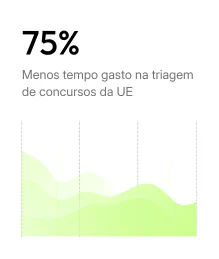


* Testes de benchmark internos (julho de 2025) mostram que um analista experiente precisa de cerca de 15 minutos¹ para realizar a qualificação inicial de uma licitação típica da UE. Com o TENDERBOT IO, esse mesmo analista pode pré-qualificar aproximadamente 150 licitações no mesmo período de 15 minutos — cerca de 10 licitações em ± 1 minuto. Isso representa uma redução no tempo de triagem de mais de 90%. Para ser conservador e cobrir variações no comprimento do documento e no estilo de trabalho, comunicamos, portanto, “até 75% de economia de tempo.
¹ O cálculo assume uma velocidade média de leitura de ~2 minutos por página A4 e um comprimento médio de licitação de ~7 páginas.